
We all have a responsibility to protect endangered species, both for their sake and for the sake of our own future generations. -Loretta Lynch

In an effort to bring native plants and animals to the remnant habitat of Camden, NJ, the RegeniSEED Project was developed by Mackenzie Mozitis at Rutgers University–Camden to aid in the revitalization of the natural landscape. What may appear to be a selection of ordinary bird seeds in a feeder is actually a strategically created formula of seeds. The bird feed mixture is 50% wild bird feed, 25% of non-treated native plant seeds, and 25% native plant seed treated with the biodegradable bioepoxy resin. This ensures that the birds will have the ability to potentially consume and digest some seeds, naturally digest or disperse the non-treated natural seeds, and release the treated seeds to allow later germination. Research shows that birds are a key vessel in the transportation of invasive species seeds as well (Mokootjomela et. al 2016). Through providing birds an average wild bird food mix, non-treated native seeds, and treated native seeds, the birds can scatter the seeds native to the region and increase their experience with the native plants. This will hopefully increase their appetite for these species and promote further dispersal of these plant seeds. According to Living Bird magazine, seed dispersal is the “most important ecological function” of birds and they are the reason the majority of the plants and trees exist in certain locations (2017).
Birds are a natural source to disperse seeds within a region they are inhabiting or migrating through. Research performed by Kleyheeg et. al suggests that the rate in which they disperse their excrement, and through that seeds, is based on their birds metabolism and activity level (2015). For this reason, it is essential to look into methods of preventing the seeds from being rapidly digested within the birds’ digestive tract. Based on research by Pawar et. al, the seeds have been treated with a biodegradable bioepoxy resin developed by combining cottonseed oil and algae oil and have successfully germinated after the resin has degraded (2016). This resin is an all natural and renewable resource that can also be applied to the seeds at varying thicknesses. Through varying the thicknesses of the biodegradable bioepoxy, an extended release could potentially increase the scope of success for this project. The hardening of the seed’s outer shell via a biodegradable bioepoxy, the birds do not digest the seed as well nor will the seeds break from rocks swallowed by the birds. Seeds will instead be allowed to pass through the digestive tract of the bird, be removed through excrement, and dispersed throughout the area the bird travels.
The ethical implications of this project primarily are concerned with the well-being of the wild birds that would be consuming this wild seed mixture. The goal would be to minimize any pain or distress the birds could incur. Birds are in search of food resources and if they were to continue to consume food, but receive no nourishment from it they would eventually starve which is why a mixture is required. This project has positive ethical concerns including, but not limited to, aiding local environments which are currently lacking in indigenous flora and fauna while also supporting the native ecosystems present in other areas. On the negative side, this project could result in some animal experimentation within a lab space as well as future testing and usage of wild animals to do the work for the project to be successful.
RegeniSEED is an effort to return natural flora and fauna to the greater Camden, NJ area. It is a method of promoting not only the growth of native plants within Camden, but also to create a more healthy environment for the residents of this local ecosystem. The damage that has been done to this ecosystem will take an unknown time to repair. RegeniSEED is a community promoted effort to repair the damages. This area is resilient and forever growing and changing. Through changing the hardness of some of these seeds, humans are being forced to modify nature in order to reverse their destruction of nature. The extended release is a notion that within time, life will continue and prosper. Humans are strong and can cause great change, but nature is more important and needs to be stronger to build a better world.

Sample Bird Feeder 
Prenanthes autumnalis – (Pine Barrens Rattlesnake Root) 
Huckleberry Bush 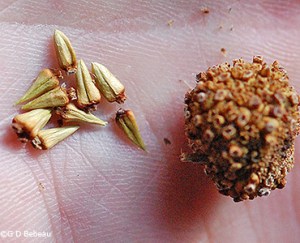
Bushbutton Seeds 
Milkweed Seeds

References
Campbell, V. (2017). Analysis: The Economic Value of Birds. Retrieved from https://www.allaboutbirds.org/news/analysis-the-economic-value-of-birds/
Kleyheeg, E., Van Leeuwen, C., Morison, M., Nolet, B., & Soons, M. (2015). Bird‐mediated seed dispersal: reduced digestive efficiency in active birds modulates the dispersal capacity of plant seeds. Oikos, 124(7), 899–907. https://doi.org/10.1111/oik.01894
Mokotjomela, T. M., Downs, C. T., Esler, K., & Knight, J. (2016). Seed dispersal effectiveness: A comparison of four bird species feeding on seeds of invasive Acacia cyclops in South Africa. South African Journal of Botany, 105, 259–263. Retrieved from https://www.sciencedirect.com/science/article/pii/S0254629915315209
Pawar, M., Kadam, A., Yemul, O., Thamke, V., & Kodam, K. (2016). Biodegradable bioepoxy resins based on epoxidized natural oil (cottonseed & algae) cured with citric and tartaric acids through solution polymerization: A renewable approach. Industrial Crops and Products, 89, 434–447. Retrieved from https://www.sciencedirect.com/science/article/pii/S0926669016303454
 Art & Sustainability